I. Overview of MPPT technology
Maximum Power Point Tracking (MPPT) is the core technology of PV power generation system. Since the output characteristics of PV cells are non-linear and their operating point changes with light intensity and temperature, MPPT controllers maximize power generation efficiency by adjusting the operating voltage of PV arrays in real time so that they always operate at the maximum power point.
According to statistics, the use of MPPT technology can increase the power generation of 20%~30% than direct connection, with significant economic benefits. The accurate execution of the MPPT algorithm depends on accurate voltage and current detection.
II. Technical requirements for PV current detection
2.1 Current range
Depending on the inverter type and power rating:
- String inverter: single MPPT current 10~20A
- Centralized inverters: bus currents up to hundreds of amps
- Microinverters: lower current, usually<15A
2.2 Precision requirements
MPPT current detection accuracy directly affects tracking efficiency:
- High-precision detection enables more accurate power calculations
- Recommended accuracy ≤ 1%, high-end products require ≤ 0.5%
- Small linear error over the full range to ensure accuracy for both large and small currents.
2.3 Dynamic response
Light changes (e.g. cloud cover) can lead to rapid changes in current, which are required by the detection circuit:
- Bandwidth > 10kHz
- Fast response to track current changes
- High anti-interference capability
2.4 Wide temperature range
PV inverters are usually installed outdoors with a wide range of operating temperatures:
- Ambient temperature: -25°C to +60°C
- Possibly higher inside the chassis
- Current sensors require good temperature stability
III. Advantages of the shunt program
3.1 High precision
The shunt can provide 0.5% or even higher accuracy to meet the needs of high-efficiency MPPT. The accuracy advantage over Hall sensors is obvious.
3.2 Good linearity
The V-I characteristics of the shunt are perfectly linear, with consistent errors for both high and low currents. This is important for applications with a wide range of light variations.
3.3 No zero drift
Hall sensors suffer from temperature zero drift, which has a significant effect over the wide temperature range of PV applications. Shunts do not have this problem.
3.4 High reliability
The shunt is a purely passive device, no power supply is required and there is no aging of the electronics. With a design life of 25 years for PV systems, reliability is critical.
3.5 Cost advantages
String inverters usually have multiple MPPTs, each requiring current detection. The cost advantage of a shunt is more obvious with multiple detection.
Fourth, the shunt selection guide
4.1 Current specifications
Selected based on the maximum input current of the MPPT, reserving 20% margin:
- 10A MPPT → optional 15A shunt
- 15A MPPT → optional 20A shunt
- 20A MPPT → optional 25A or 30A shunt
4.2 Resistance Selection
Balancing accuracy and power consumption:
- Low resistance (e.g. 1mΩ): small power consumption, but weak signal, high requirements for op-amps
- Medium resistance (e.g. 5mΩ): moderate signal, acceptable power consumption
- Higher resistance (e.g. 10mΩ): strong signal, but power consumption of 4W at 20A
String inverters commonly use 5~10mΩ shunts.
4.3 Temperature coefficient
Wide temperature range for photovoltaic applications, TCR ≤ 50ppm/°C is recommended, ≤ 30ppm/°C is preferred.
4.4 Forms of encapsulation
- chip-based: Suitable for low current, direct PCB soldering
- plug-in (software): Suitable for medium currents and easy heat dissipation
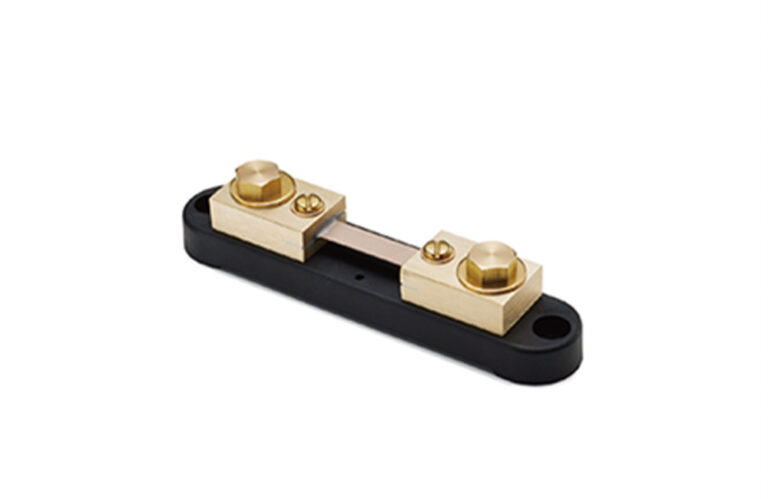
- bolt pattern: suitable for high currents, requires separate installation
V. Circuit design points
5.1 Signal Conditioning
- Use of high-precision op-amps or current-sense amplifiers
- Gain setting matches ADC input range
- Add low-pass filtering to suppress switching noise
5.2 Common Mode Voltage Handling
Photovoltaic arrays with output voltages of up to 1000V or more are required:
- Differential amplification with high common mode rejection ratio
- Or use a segregation program
5.3 PCB Layout
- Adequate width for high current alignment
- Voltage sense line is thin and away from the power line
- Four-terminal connection method
5.4 Thermal Design
The power consumption of the shunt is small, but heat dissipation still needs to be considered in a sealed chassis:
- PCB Copper Foil Heat Dissipation
- Good contact with the radiator
- Avoid hot spots affecting other components
VI. MPPT algorithm and current detection
6.1 Perturbation Observation Method (P&O)
The most commonly used MPPT algorithm determines the direction of adjustment by changing the operating point in small increments and comparing the power changes. Moderate requirements for current detection accuracy.
6.2 Incremental conductivity method (INC)
Determining the maximum power point based on the relationship dI/dV = -I/V requires higher current and voltage detection accuracy.
6.3 Intelligent Algorithms
Intelligent algorithms such as fuzzy control and neural network are gradually applied, which have high requirements on the accuracy and dynamic response of current detection.
VII. Application cases
7.1 A brand of string inverter
60kW string inverter, 4-way MPPT, 15A each:
- Shunt: 5mΩ/20A, accuracy 0.5%
- Signal Conditioning: Specialized Current Detection Chip
- ADC: 16-bit SAR type, sampling rate 100kHz
- Measured MPPT efficiency: >99.5%
7.2 Microinverters of a certain brand
300W microinverter with single MPPT:
- Shunt: 10mΩ/15A, SMD package
- ADC detection integrated within the host controller
- Cost-optimized, performance to meet demand
VIII. Market trends
8.1 High Power Modules
As PV module power increases (600W+), the MPPT input current increases, placing higher demands on the shunt specifications.
8.2 Multiple MPPT
To accommodate complex roofs and partially shaded scenarios, the number of string inverter MPPT paths increases, and shunt usage rises.
8.3 Intelligent
The inverter is interconnected with the cloud platform to monitor power generation data in real time, which raises the requirements for current detection accuracy and long-term stability.
IX. Summary
With high precision, high reliability and cost advantages, the shunt has become the mainstream solution for MPPT current detection in PV inverters. When selecting the type, it is necessary to consider the current specification, accuracy requirements, temperature range and other factors, and pay attention to the details of signal conditioning, common mode processing and heat dissipation in the circuit design. With the continuous development of the PV industry, the shunt will play an increasingly important role in efficient power generation.