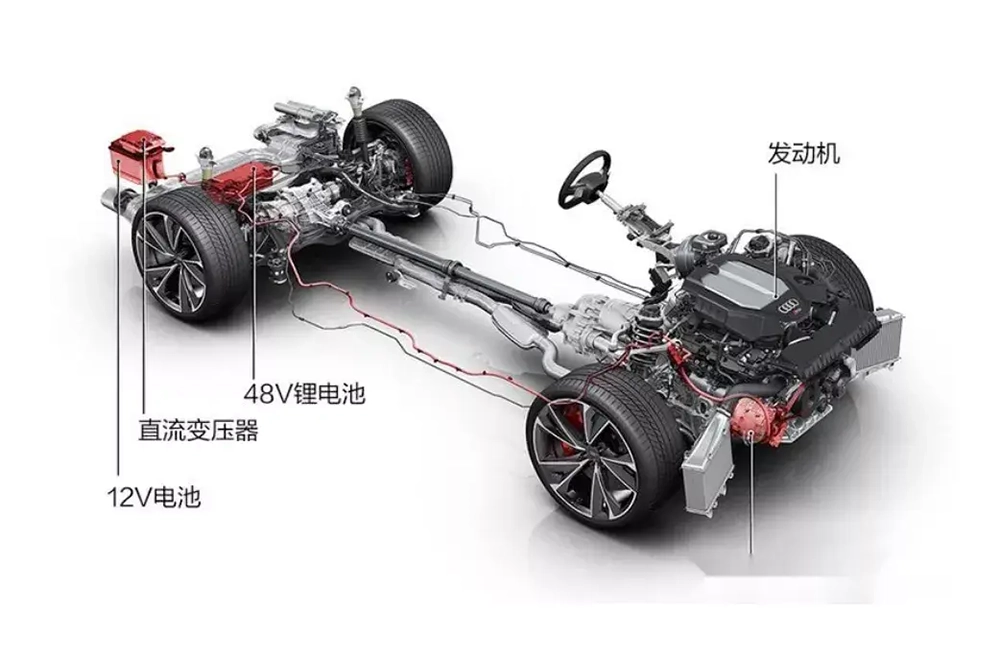
Project Background
48V light hybrid system is an important transition solution for vehicle electrification, which can effectively reduce the whole vehicle fuel consumption by 10-15%, and at the same time reduce CO₂ emissions. An internationally renowned automotive parts Tier 1 supplier (Tier 1) is developing a new generation of 48V BMS modules for a number of mainstream European automobile companies, and needs a high-precision, high-reliability current detection solution.
System specifications requirements:
- Measuring range: ±250A bidirectional current
- Measurement accuracy: better than ±1% over the full temperature range
- Operating temperature: -40°C to +85°C (storage temperature -40°C to +125°C)
- Service life: 15 years/300,000 kilometers
- Certification Requirements: AEC-Q200 Automotive Grade Certification
Technical challenges faced
1. Wide temperature range accuracy maintained
The ambient temperature of automotive applications varies greatly, from -40°C in the winter in Northern Europe to 85°C or even higher in the engine compartment in the summer. Conventional copper-manganese alloy shunts have a temperature coefficient of about ±100ppm/°C, and the resistance value can change up to 1.25% within the temperature variation range of 125°C, which is not able to meet the accuracy requirement of ±1%.
2. Wide dynamic range measurements
The 48V system's current varies greatly over the range of different operating conditions: the battery self-discharge is only a few tens of milliamps when idling and stopping, while the current during rapid acceleration or energy recovery can be as high as 200-250 A. The system needs to maintain sufficient measurement accuracy over the entire range, with a dynamic range of more than 1:10,000.
3. Power loss and heat dissipation
The power loss of the shunt at high currents is converted into heat. If a larger resistance value is chosen for better signal amplitude, the power loss increases; too small a resistance value results in a weak signal that is susceptible to noise. A balance needs to be struck between the two.
4. Vehicle-grade reliability
The automotive environment is harsh, and the shunt needs to withstand mechanical vibration, temperature shock, humidity and heat cycles, and maintain stable performance over a 15-year service life. Products need to pass AEC-Q200 and other automotive grade certification tests.
Technical Solutions
1. Shunt sizing and design
After detailed technical analysis and comparison testing, the FL-U type 200µΩ shunt was finally selected with a rated current of 300A (leaving 20% margin for 250A maximum operating current). Key parameters:
- Resistance value: 200µΩ ±0.5%
- Rated voltage drop: 60mV @300A
- Temperature Coefficient (TCR):<25ppm>
- Thermoelectric potential (EMF):<3µV/°C
- Long-term stability:<50ppm>
At 250A full load current, the shunt generates a 50mV signal at both ends with a power loss of 12.5 W. This signal amplitude ensures a sufficient signal-to-noise ratio, while the power consumption is within acceptable limits.
2. Materials and processes
The shunt resistor body is made of selected high-purity manganese-copper alloy (Cu-Mn-Ni), which has a very low temperature coefficient and thermal potential and is the preferred material for precision shunts. The resistor body and copper terminals are welded by electron beam welding process, which has high strength of weld seam, small heat affected zone, and no false welding or cracking under long-term thermal cycle.
3. Four-terminal (Kelvin) connection design
Adopting the standard four-terminal measurement method, the current circuit (C+, C-) and voltage measurement circuit (S+, S-) are completely separated. The voltage sampling point is set inside the resistor body, effectively eliminating the influence of lead wire resistance and contact resistance on the measurement accuracy, which can improve the measurement accuracy by more than 0.1%.
4. Compact structural design
Adopting U-shape structure design, the external dimension is only 35mm×15mm×8mm, which is easy to be laid out in a compact BMS module. The shunt is directly connected to the negative battery busbar, shortening the high current path and reducing contact resistance and EMC risk.
System Integration and Testing
The shunt is used in conjunction with TI's INA240-Q1 high-precision current-sense amplifier, which has the following features:
- Gain options: 20V/V, 50V/V, 100V/V, 200V/V
- Common mode voltage range: -4V to +80V
- Offset voltage: ±25µV (max)
- Gain error: ±0.2% (max)
- Bandwidth: 400kHz
The system undergoes rigorous validation testing:
- Temperature cycling test: -40°C ↔ +125°C, 1000 cycles
- High temperature working life: +125℃, 1000 hours
- Temperature and humidity cycling: +85°C/85%RH, 1000 hours
- Mechanical vibration: 10-500 Hz, according to ISO 16750-3.
- Mechanical shock: 50g/11ms
- Salt spray test: 96 hours
Project results
- Precision metrics:System current measurement accuracy of ±0.8% over the full temperature range of -40°C to +85°C, better than the design target of ±1%
- SoC accuracy:Improved SoC (state of charge) estimation accuracy of ±3% based on high-precision coulomb counts, significantly better than the industry average of ±5%
- Reliability:Products have passed all AEC-Q200 automotive grade reliability tests with full PPAP documentation
- Bulk supply:Mass production starts in 2023, with over 800,000 units delivered to date
- Customer Recognition:Applied in 48V light hybrid models of many famous European automobile brands, with good customer feedback.
Summary of technical parameters
| parameters | norm |
|---|---|
| Splitter type | FL-U-200µΩ-300A |
| Resistance value | 200µΩ ±0.5% |
| Rated current | 300A |
| Operating Current | 250A (max) |
| System measurement accuracy | ±0.8% (-40°C~+85°C) |
| temperature coefficient | <25ppm> |
| Rated power consumption | 12.5W @250A |
| operating temperature | -40°C ~ +85°C |
| accreditation | AEC-Q200 |